Français
  English
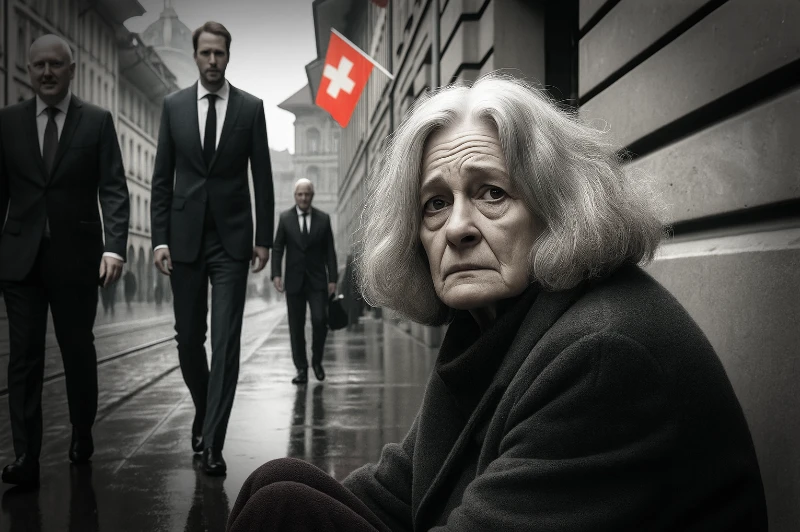
 SWITZERLAND - AHV - SWISS PENSIONERS ARE WORSE OFF THAN THEIR NEIGHBOURS
Compared with the rest of Europe, the Swiss receive high pensions, but their purchasing power plummets when adjusted for inflation. The retirement age is, however, lower than in some neighbouring countries.
We have known for a long time that Swiss pensions (AVS – for those who will receive it… and possibly the 2nd and 3rd pillars) will not be enough to cover the costs of future pensioners who wish to continue living in Switzerland.
This grim prospect has long been hidden from the working population, but like any lie, at some point it can no longer be concealed.
So what can be done?
There is the option of moving abroad, which many have already done successfully, or of staying but living in poverty on supplementary benefits… (a fine reward after so many years of hard work).
As you will read in the excellent comparative article below, taken from the newspaper 20 Minutes, Europeans, with their low wages and small pensions, are far better off than the Swiss with their ‘highest average wage in the world’… But also with the highest cost of living in the world…
But why do Europeans fare better than the Swiss?
If we set aside the fact that the cost of living is considerably lower, the majority of Europeans own their own homes, on which they generally pay no tax if it is their main residence, which is a very important point!
The solution for the future is to build up your own future income, rather than relying solely on the state or an institution to provide it for you.
In less than a month, the Swiss will vote on their pension reform. At the heart of the debate are the system’s funding, the amounts paid out, and the age at which people can claim their old-age pensions. And what is the situation in other European countries? Are older people better or worse off than in Switzerland? *20 Minuten* has attempted to answer these questions.
Average retirement age
In Switzerland, officially and prior to 24 September, men retire at 65, whilst women retire at 64. According to OECD figures, however, the actual retirement age is higher, averaging 66.3 for men and 64.5 for women. The situation in our small country is in line with the European average, and whilst most of our neighbours work for shorter periods, either officially or in practice, others are currently reforming their systems to push back the retirement age.
French people can retire from the age of 62, provided they have made contributions for 41 years, or from the age of 67. However, the actual retirement age is between 59 and 60 for both men and women. In Austria, the statutory retirement age is 65, but the actual retirement age is 62.2 for men and 60.2 for women. In Germany, retirement at 67 will soon become a reality, whilst the official age is currently 65.5, and the actual age is 62.7 for both genders. In Italy, the retirement age will be 67 from 2021, with greater flexibility offered by a private scheme. The actual retirement age is currently just over 61 for both men and women. The Portuguese will also move to the 67-year threshold, currently set at 66. The actual retirement age is already 67 for men and 66.2 for women
Lower real pensions
The average annual pension in Switzerland stands at 22,844 francs per capita, which is higher than in neighbouring countries. However, when adjusted for real purchasing power, this figure amounts to just 14,657 francs. This is therefore lower than in most of our neighbouring countries.
In Germany, the average pension per person is 15,549 francs, or 15,195 francs when adjusted. Italians, meanwhile, receive 17,836 francs, which amounts to 17,282 francs in real terms. French pensions amount to 18,717 francs per year, or 17,372 francs when adjusted.
The top performers are the Austrians, who receive an average of 22,791 francs per year, or 20,790 francs in real terms in terms of purchasing power. At the other end of the spectrum is Portugal, which pays an average of 10,357 francs per year to its pensioners, or 12,903 francs in real terms.
Financial insecurity among older people
When comparing the amounts paid to pensioners with the standard of living of the rest of the population, it is clear that the Swiss seem to be off to a bad start. Indeed, 23.4% of older people receive less than half the average Swiss wage. It should be noted, however, that this figure does not take into account the third pillar of pension provision – that is, its optional and voluntary component – nor does it account for individuals’ personal wealth.
By way of comparison, the proportion of older people considered to be living in poverty elsewhere in Europe stands at 9.4% in Germany and Italy, 11.4% in Austria, and 8.1% in Portugal. At the very bottom of the list, France has only 3.8% of older people receiving less than half the country’s average wage.
A comparison of pensions between Switzerland and its European neighbours
When do Europeans retire and how much money do they receive from the state?
Some of our neighbouring countries are much more generous, and poverty among the elderly is less common there.
Switzerland
In this country, men retire at 65 and women at 64. However, the actual retirement age is higher: according to OECD figures, men work on average until the age of 66.3, whilst women retire at 64.5. According to Eurostat figures, per capita pension expenditure in Switzerland amounts to 22,844 francs per year. Taking differences in purchasing power into account, this figure still stands at 14,657 francs. This is less than what is paid in our neighbouring countries. These figures relate to funds from the first and second pillars; funds from private pension provision (third pillar) are not included. Poverty among older people is significantly higher in Switzerland than in our European neighbours: 23.4 per cent of pensioners receive less than half the average wage. At 6.4 per cent, the share of pension expenditure in gross domestic product (GDP) is relatively low compared to the rest of Europe.
Germany
A retirement age of 67 will soon be a reality for our northern neighbour. Germans currently in retirement can still benefit from a retirement age of 65.5, but this age will increase by one to two months each year until the retirement age of 67 is reached in 2031. In reality, Germans retire earlier. On average, men and women leave the labour market at the age of 62.7 – and accept reductions in their pensions. The state pays an average of CHF 15,549 per person per year. Adjusted for purchasing power, Germans receive CHF 15,195, which is slightly more than the Swiss. The proportion of older people living in poverty is 9.4%. The cost of the pension system amounts to 10.1 per cent of GDP.
Italy
Until the early 2000s, Italian pensioners enjoyed generous benefits: the state generally guaranteed a pension of up to 80% of their final salary. Retirement began at the age of 57 and only a few Italians relied on a private pension scheme. The system was reformed in 2004 and 2011, and by 2021, the retirement age in Italy will also be 67. Social benefits are still relatively generous. Pension expenditure per person amounts to CHF 17,836 per year, or CHF 17,282 in real terms. Consequently, Italy has record pension expenditure of 16.3% of GDP. As in Germany, 9.4% of pensioners are considered to be living in poverty.
France
In France, as recently as 2009, people could retire at 60. However, the French also face problems with funding the system, which is why it was decided in 2010 to gradually raise the retirement age to 62 – this target was reached in 2017. However, to receive a full pension, 41 years of contributions are required. From the age of 67, the full pension is automatically paid.
But the actual retirement age remains below 60: men work on average until the age of 59.4, and women until the age of 59.8. Annual expenditure per pensioner in France amounts to 18,717 francs, or 17,372 francs in purchasing power parity. At 3.8%, poverty among the elderly is low, whilst expenditure is relatively high, at 13.8% of GDP.
Austria
Our neighbouring country is very generous when it comes to pensions. Each pensioner receives an average of CHF 22,791 per year, or CHF 20,790 at purchasing power parity. In Austria too, the retirement age has been raised, but only for women: until now, they retired at 60; those born after 1955 must accept the gradual increase in the retirement age to 65, which also applies to men. The actual retirement age is lower, at 62.2 years for men and 60.2 years for women. This system costs Austria 13.6 per cent of its GDP, and at 11.4 per cent, poverty among the elderly is around the average.
Portugal
In Portugal, there is less state funding than in Switzerland: the cost per pensioner amounts to 10,357 francs (12,903 francs at constant purchasing power). Nevertheless, only 8.1 per cent of pensioners are considered poor. Women and men retire at 66, whilst the statutory retirement age for men is set at 67. The actual retirement age for men is already 67, and for women, at 66.2, it is also higher than the statutory age. Despite these strict conditions, the pension system is relatively expensive in Portugal, accounting for 14% of GDP.
N.B.: The figures given in this article take into account the average of the first and second pillars. This therefore does not include the third pillar or the personal wealth of pensioners. The figures compared should therefore be treated with caution.
By Pauline Rumpf