Français
  English
 SWITZERLAND - FORECASTS FOR 2050: THE CAR WILL REMAIN THE KING OF THE FUTURE
The Swiss Confederation has analysed mobility trends up to 2050 based on various scenarios. Things are not expected to change significantly.
Of course, the car will remain the preferred mode of transport all over the world... Even in Switzerland, despite the relentless attempts by those green-leaning, urban, caviar-eating communists to do away with it... Pathetic... because these fundamentalists have never managed to grasp that there isn’t just one ideal mode of transport!
The reality is that there are a wide variety of transport modes, all of which are excellent and suited to different people; the sensible approach would be to prioritise smooth traffic flow for ALL MODES OF TRANSPORT!
In most of the world’s major cities, traffic lights have been drastically reduced in favour of roundabouts wherever possible, in order to keep traffic flowing smoothly at all times, and it works perfectly; it is only in certain cities with an extremist-leftist bent that the number of traffic lights has skyrocketed with the sole aim of punishing motorists, as over 80% of cyclists do not obey red lights.
Nevertheless, in the end, there will always be fewer cars in town, as city life is a thing of the past; so let’s allow the fundamentalist-bobos to live happily in their ‘natural urban habitat’ and, with respect and love, let’s move to places in the heart of unspoilt countryside thanks to remote working. The facts are clear: cities are becoming depopulated across the West, whilst the countryside is being repopulated, offering a far better quality of life
A truly healthy lifestyle is now within reach of the vast majority thanks to technology and also thanks to this pandemic, which has enabled companies to realise all the benefits of teleworking in terms of productivity, savings and profitability.
We must now realise that, despite the fact that there will be fewer and fewer commuters, there will be more and more electric vehicles on the road, and it will be essential to massively increase the number of charging stations everywhere to avoid the inevitable ‘bumpers-to-bumpers’ traffic jams caused by vehicles running out of power in traffic, on roads or motorways.
This is why it is essential to invest in renewable energy power stations in order to achieve energy independence in the face of demand that is set to grow exponentially in the coming years.
Alain Farrugia
Below is the article from 20 Minutes
Switzerland is not on the road to a mobility revolution. The Federal Office for Spatial Development (ARE) published its ‘Transport Outlook 2050’ on Tuesday. Its assessment, taking into account societal changes and current trends, is that the volume of travel will increase (+11% from 2017 to 2050), but less than the expected population growth (+21%).
Several factors need to be taken into account. “The outlook is based on the assumption that remote working will become a permanent feature of daily life,” says the ARE, which estimates that “people whose jobs allow it will spend 50% of their working time at home”. Commutes between home and work will therefore decrease. The office also notes that “as online shopping remains on a growth trajectory, all scenarios anticipate an increase in deliveries” and, conversely, a decrease in individual journeys for shopping. Leisure travel, however, is expected to increase further.
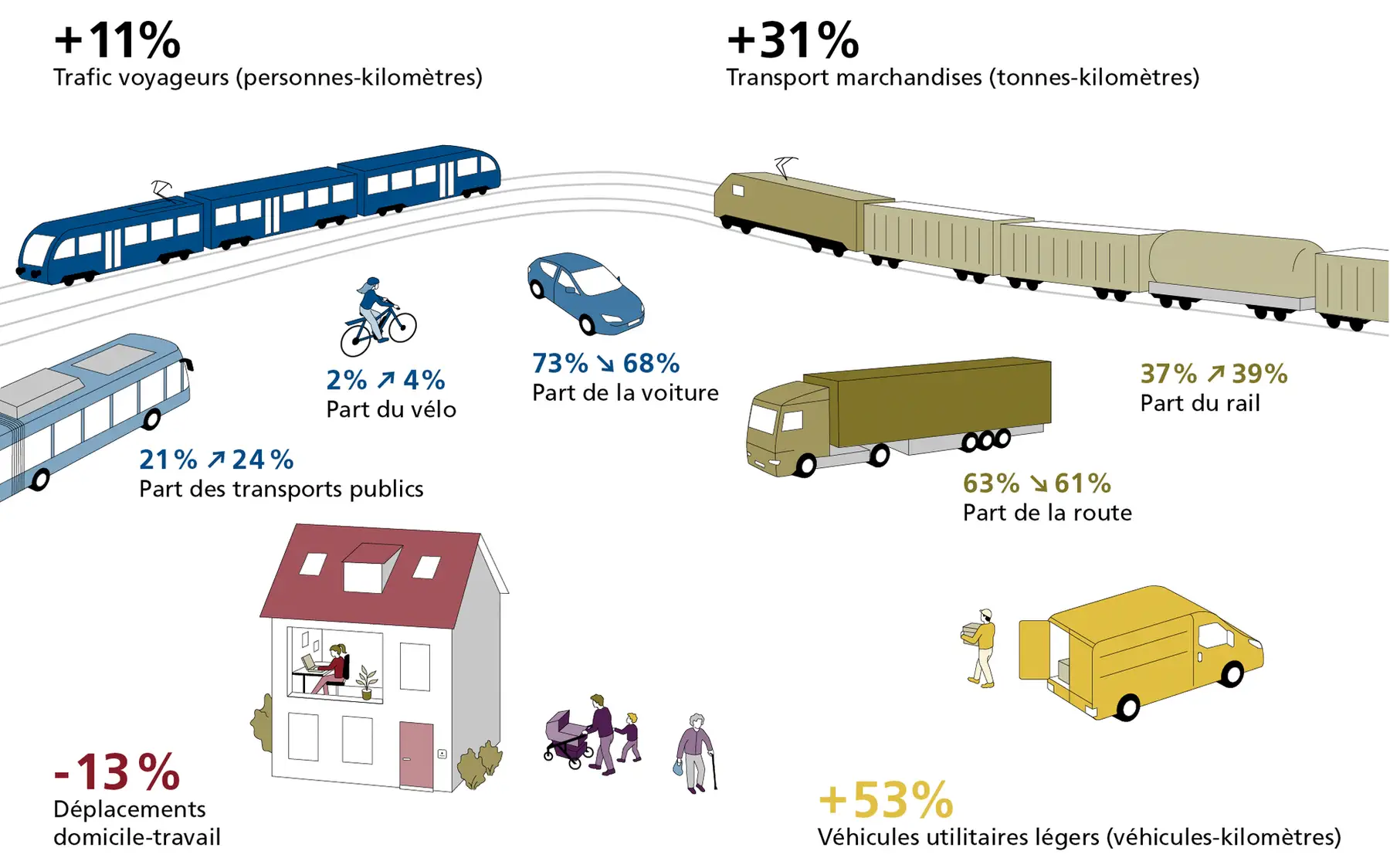
Whilst the public transport sector and environmentalists are pushing to increase the share of rail and soft mobility in transport, the car still has a bright future ahead of it. According to the ARE’s main scenario, the share of car journeys will fall from 73% to 68% of total ‘person-kilometres’ – the unit of measurement used – over just over thirty years. Cycling will double, but will account for only 4% of the total. Public transport will rise from 21% to 24%. “The use of public transport will be particularly striking for long distances,” the report states.
Cars, but which ones?
In absolute terms, car travel is expected to increase slightly, driven by a significant rise in goods and deliveries, whilst the number of people travelling by passenger car will decline, “notably due to the higher cost of using them”. The ARE notes that autonomous or semi-autonomous cars will experience a boom, particularly between 2040 and 2050, and could account for 32% of passenger cars by that time. “Even if car use tends to decline, two out of every three kilometres will still be travelled by car in 2050,” concludes the ARE.
Sustainable or individualistic?
The above assumptions are based on a scenario that takes into account measures taken or already decided upon in the field of sustainable development. As the ARE does not have a crystal ball, it has also envisaged other scenarios, including that of a “sustainable society”, should the population accept an even greener shift, and that of an “individualised society”, where technological progress would be harnessed to serve individual interests. In the baseline scenario, for example, it is expected that around 50% of cars will be electric by 2050. In the ‘sustainable’ scenario, this figure would reach 85% (and the cars would be smaller), and in the ‘individualised’ scenario, 44% (including many large vehicles).