Français
  English
 SWITZERLAND – PROPERTY PRICES: ‘MANY PEOPLE CAN NO LONGER AFFORD TO BUY A HOME’
Due to rising property prices, the dream of owning a home is becoming increasingly out of reach in Switzerland. An expert’s view
Buying a home is becoming increasingly difficult for many people.
A close look at the TRUE and FALSE claims in this particularly interesting article on the Swiss property market and its affordability, which is being deliberately made increasingly out of reach for the majority of workers from the former middle class.
House and flat prices are currently soaring in almost every part of the world. The year-on-year increase is the highest since 2006, the year just before the subprime crisis in the United States in 2008–2009. In Switzerland, houses and flats are also more expensive than last year.
TRUE and FALSE: Of course, in certain regions such as Switzerland, London, Hong Kong and some French cities, property prices have risen, but there have also been significant falls in other regions such as Thailand, Cambodia, Portugal and Italy… If a detailed analysis were carried out, it is not certain that the increase would outweigh the decrease.
For young families in particular, the dream of owning a home is therefore becoming increasingly difficult to achieve. Who can afford to buy a property? Is the next property crisis imminent? Property expert Stefan Heitmann from Moneypark* spoke to ‘20 Minuten’.
TRUE: In Switzerland, it has become virtually impossible for a worker or a young family from the former middle class to get on the property ladder.
Is the situation in the Swiss property market dire?
Stefan Heitmann: The pandemic has fuelled strong demand. At the same time, fewer properties are coming onto the market, as older people, in particular, do not want to sell at the moment. This is widening the imbalance between supply and demand.
TRUE: It is dire for the average person, who has no choice but to run themselves into the ground paying exorbitant rents for properties that are often of poor quality in the big cities.
Why is home ownership so highly prized today?
It is a lifelong dream for the vast majority of us. The home is the centre of our lives, particularly for families. This has only increased during the pandemic.
TRUE – The pandemic and remote working have made the Swiss realise the need for a home that can accommodate one or two comfortable workspaces.
FALSE – It is no longer even the dream of the vast majority of the population, as they are well aware that home ownership has been made virtually impossible for them.
How much more do you have to pay for a property at the moment?
We note that average prices are 10 to 15% higher than the valuation. But in some cases, they can be significantly higher.
TRUE: In Switzerland, prices are always rising.
How high will prices go?
We assume that property prices will continue to rise, but not indefinitely, because we are already seeing many potential buyers who can no longer afford to buy a home. The market therefore corrects itself automatically when demand falls.
TRUE: The market dips slightly and then recovers
What are the consequences for the middle class?
Unfortunately, many first-time buyers are now finding it difficult to secure a mortgage. We are therefore calling for more innovative mortgage schemes to be introduced to help young families who want to buy a home. Because home ownership remains financially attractive: homeowners save up to 50% on housing costs compared to a similar rented property.
TRUE, BUT NOT ONLY THAT…: But the main reason is that everything is in place to prevent people from becoming homeowners, as Switzerland is built solely on a model of tenants, not owners!
Should we fear the next property crisis?
Not in Switzerland, as the market is much more regulated than abroad. These measures have a corrective effect. It is therefore a healthy market, but one in which it is unfortunately becoming increasingly difficult to buy a property.
FALSE: Obviously, the property market in Switzerland is extremely unhealthy because it is manipulated by a tiny minority of very large players and, above all, by the state, which sets rules that prevent people without a comfortable personal fortune or very high incomes from accessing home ownership…
Civil servants, on the other hand, are very much favoured when it comes to flats in development zones; indeed, it is the new Swiss bourgeoisie who can still hope to buy property on favourable terms.
What are the consequences of these regulations?
If you regulate a market so strictly, you force people to rent at higher prices and prevent them from buying their own homes. But we are all partly to blame too. In Switzerland, people buy very late in life and then stay in that property, which makes Switzerland a ‘buy and die’ market (editor’s note: you buy a property and die there).
TRUE: Regarding the late age at which people become homeowners.
FALSE: Regarding the “buy and die” aspect, because once a homeowner is placed in a care home, their property is sold to pay for the average annual care costs of over CHF 120,000… Former homeowners therefore die penniless, leaving their children nothing but debt!
Do low mortgage rates exacerbate rising prices?
No, the problem has not been caused by low interest rates, but by the low supply of properties on the market. Furthermore, the financial criteria that a mortgage borrower must meet remain strict and do not take into account the lower interest rates on the market.
TRUE: Financial criteria are in place to prevent people from getting on the property ladder… the use of the second pillar, for example, with the amount of equity required.
Rising property prices
The property consultancy Knight Frank studied the trend in house and flat prices in 56 countries between March 2020 and March 2021. On average, prices rose by 7.3%. In 13 countries, the increase was even in double figures, whilst in Switzerland it stood at 6.5%. The reasons for the rise in property prices are almost the same everywhere: there is not enough new-build housing, whilst more and more people want their own home, especially following the Covid crisis. Demand therefore outstrips supply.
TRUE: but in other countries around the world, home ownership is very much encouraged; even though banks now scrutinise prospective buyers’ debt levels more closely, their lending conditions are nowhere near as restrictive as in Switzerland

*Stefan Heitmann is the founder and CEO of the Swiss mortgage specialist Moneypark. The TX Group, which also owns ‘20 minutes’, has a stake in Moneypark
We won’t, of course, be calling this a biased article…
CONCLUSION:
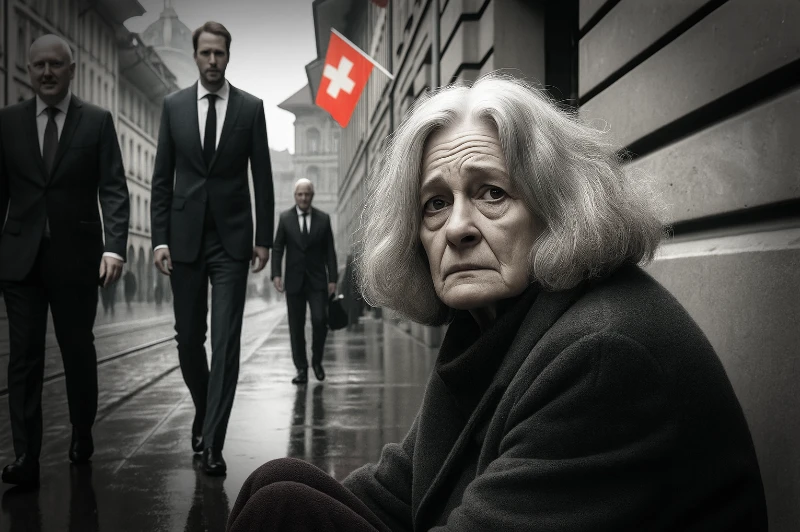
In Switzerland, the average citizen must absolutely remain a tenant for life!
They must NEVER own property and must ABSOLUTELY NOT have access to investment property, as they must remain TOTALLY dependent on their job, their AHV (the lowest on the continent) and the second pillar, whose conversion rates are constantly falling.
A good citizen in Switzerland must remain a tenant and part of a circular economy so that, once retired, after having worked very hard all their life, they may die peacefully in poverty and with the pride of having fulfilled their patriotic duty.
Alain Farrugia