Français
  English
 AFTER THE NUCLEAR WEAPON, THE AI WEAPON - THE NEW STRATEGIC POWER IS INFRASTRUCTURE
For nearly a century, strategic power has been measured by the ability to destroy!
The nuclear weapon remains its ultimate expression!
Precisely because its consequences would be catastrophic, its use remains difficult to conceive, and the powers that possess it will likely continue to maintain it as a deterrent instrument. However, another form of power is emerging.
It no longer primarily relies on destruction, but on the ability to produce, supply, secure, and develop artificial intelligence at the scale of a sovereign ecosystem: data, materials, hardware, software, computing, networks, cybersecurity, industry, and energy. This transformation could disrupt the geopolitics of power.
The new power will not just be AI. It will be its mastery.
AI is advancing at a dizzying pace. The article from 20 Minutes about Jacob Coxon, a researcher who left OpenAI and then Anthropic, raises an essential question: what happens when those who develop the most powerful systems start to worry about the race for superintelligence themselves?
For me, the debate needs to go further.
The true power will not just be owning an AI, but having everything that allows for its production, feeding, securing, and evolving.
This means bringing together territory, energy, materials, hardware, networks, computing, software, models, data, cybersecurity, and human skills, within a single ecosystem capable of functioning with minimal critical dependencies.
It is this technological sovereignty that will make the difference.
For an exceptional AI remains vulnerable if its operation depends on processors, software, networks, energy, or infrastructures that cannot be controlled, secured, or replaced.
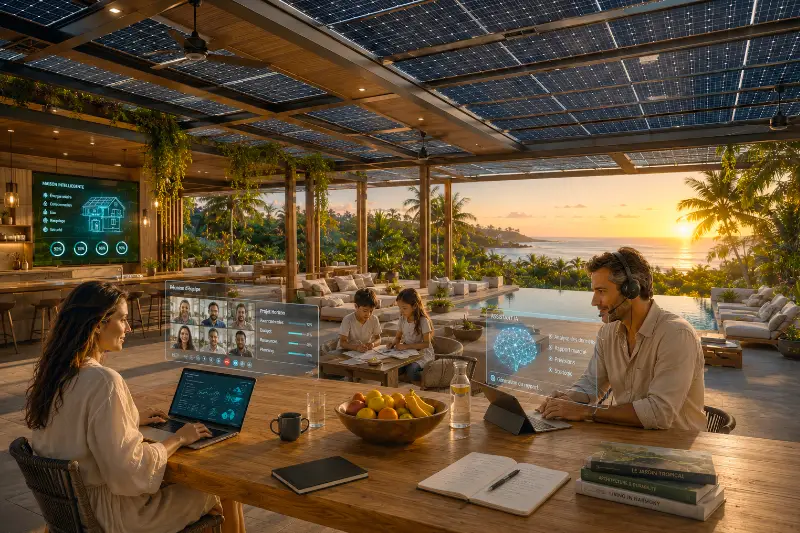
That is why the next model could go beyond the simple "data centre": the AI Campus.
A territory integrating renewable energy, high-performance computing, research, industry, cybersecurity, training, housing, and services, designed to foster a complete and resilient technological ecosystem.
The nuclear bomb will continue its role of deterrence.
But at the same time, another race is already underway: that of technological autonomy.
The power of tomorrow will belong to those who can transform energy into computing, computing into intelligence, intelligence into decisions, and decisions into industrial power.
The question is no longer just: who will have the best AI?
But: Who will have the ecosystem necessary to remain in control of their intelligence, infrastructure, and future?
Alain Farugia
THE BOMB WILL REMAIN - POWER CHANGES NATURE
It would be premature to declare the nuclear weapon obsolete.
It will likely remain for a long time an ultimate guarantee against existential aggression. But it produces neither growth, nor innovation, nor infrastructure, nor skills. It deters!
Artificial intelligence, on the other hand, can intervene in almost every sector that builds a country's power: scientific research, industry, health, agriculture, finance, energy, defence, or administration.
The difference is fundamental: the bomb can prevent a war; intelligence can help transform an economy.
This is where the paradigm shift lies; we no longer destroy, we control... And that is much more effective.
AI IS NOT SOFTWARE. IT IS INFRASTRUCTURE
Advanced artificial intelligence relies on a complex industrial chain: materials, processors, storage, networks, data centres, software, models, data, energy, and human skills.
To this chain is added a requirement that has become strategic: security.
Cybersecurity, identity, authentication, protected communications, and robust cryptography, capable of evolving towards post-quantum standards, must be integrated from the design stage.
The challenge is therefore not to make a supposedly unbreakable system — no system can guarantee that — but to build infrastructures that are resilient, auditable, verifiable, and capable of continuing to function despite a compromise or an attack.
This approach leads to a broader notion: technological sovereignty.
It does not consist of making everything oneself, which would be unrealistic, but of identifying and securing dependencies whose disruption could jeopardise the functioning of the whole.
ENERGY BECOMES THE CRITICAL FACTOR
One element remains without which nothing works: energy.
The computing capacities required for AI models are gradually transforming data centres into industrial infrastructures. Their development therefore raises a simple question: where to find abundant, reliable, and economically sustainable electricity?
The answer cannot be to reserve more and more energy for a few digital infrastructures.
The challenge is to develop renewable and storage capacities that are sufficiently large to supply both computing, industry, transport, agriculture, public services, and populations.
Energy thus becomes more than an operating cost.
It becomes a strategic infrastructure.
And the more computing capacities increase, the more this relationship becomes circular:
Energy fuels computing; computing produces intelligence; intelligence optimises energy use and accelerates innovation.
FROM DATA CENTRE TO AI CAMPUS
This is where a new territorial model could emerge.
Rather than setting up vast data centres in isolation, why not design real AI Campuses?
Computing would be associated with research centres, laboratories, technology companies, industrial infrastructures, training, and secure networks.
But also with housing, schools, health services, shops, sports and cultural facilities, as well as local agricultural production.
The AI Campus would therefore no longer be just a building filled with servers.
It would be a territory organised around the convergence of energy, computing, research, industry, and daily life.
An ecosystem capable of attracting researchers, engineers, entrepreneurs, students, industrialists, investors, and families.
The proximity between research, computing, prototyping, industrialisation, and funding could significantly reduce the time separating an idea from its market launch.
The speed of innovation would itself become a strategic advantage.
THE NEW DETERRENCE = BEING HARD TO PARALYSE
This evolution could also transform the notion of deterrence.
Nuclear deterrence relies on a logic of retaliation:
If you destroy me, I can destroy you.
Technological sovereignty introduces another logic:
If you try to paralyse me, I have the capabilities necessary to continue functioning, defend myself, infiltrate you, destroy you, and rebuild myself.
This requires redundancy, energy capabilities, computing, secure data, resilient networks, an industry capable of producing and repairing, but also human skills.
Power then no longer depends solely on what one possesses.
It depends on what one is capable of creating and maintaining.
SPEED WILL BECOME A FACTOR OF POWER
However, there remains one last advantage to conquer: time.
Building an AI Campus requires land, energy, networks, permits, capital, skills, and industrial coordination.
Two territories with comparable resources can therefore experience radically different trajectories if one builds in a few years while the other takes a decade to decide.
The ability to decide, authorise, finance, and build quickly could thus become a full-fledged factor of power.
For the true advantage of an AI Campus does not lie in a building or in a few thousand processors.
It lies in the ecosystem effect:
- Computing attracts research;
- Research attracts talent;
- Talent attracts companies;
- Companies attract capital;
- Capital accelerates innovation;
And innovation in turn increases the needs for computing and energy.
THE NEW SUPERPOWER
The power of the 20th century was built around resources, heavy industry, armaments, and the capacity for destruction.
That of the 21st century could be built around another capacity:
Transforming energy into computing, computing into intelligence, intelligence into decisions, and decisions into industrial power.
The nuclear weapon will likely remain in arsenals, perhaps to be kept without ever being used.
Meanwhile, another race is already underway.
It revolves around materials, data, computing, software, components, cybersecurity, energy, industry, and territories capable of bringing these forces together.
The strategic question will therefore no longer be just who possesses the best artificial intelligence.
It will be about:
Who possesses the ecosystem capable of producing, feeding, securing, evolving, and continuing to function when external dependencies become a risk.
The next superpower may not be the one with the most weapons. It will be the one that has managed, even today, to build the absolute sovereignty of its intelligence production.
CONCLUSION
The time for reflection is over!
The window of opportunity to establish this dominance is closing rapidly, as ecosystems that are not built right now risk becoming, in the coming years, mere strategic dependencies in the face of those who have taken the lead.
SOURCES:
https://www.iris-france.org/geopolitique-de-lia-quels-nouveaux-rapports-de-force-mondiaux/
https://shs.cairn.info/grand-atlas-2026--9782080493675-page-116?lang=fr
https://www.bcg.com/publications/2026/what-happens-when-europes-data-stops-flowing