Français
  English
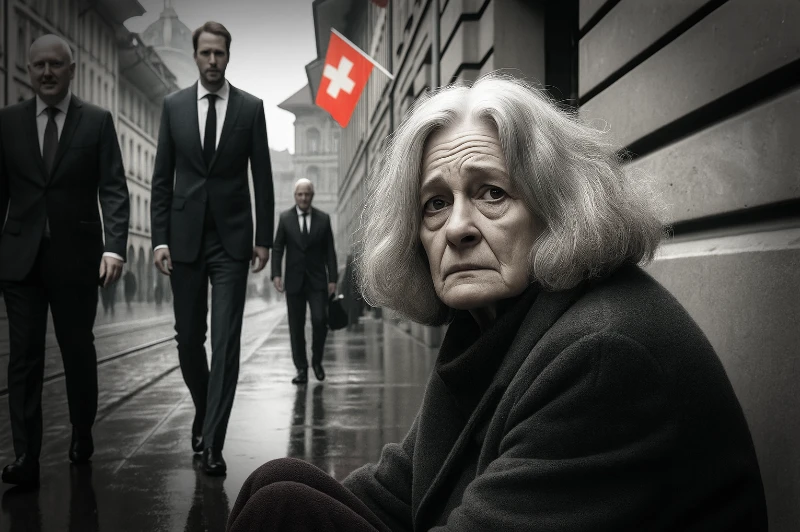
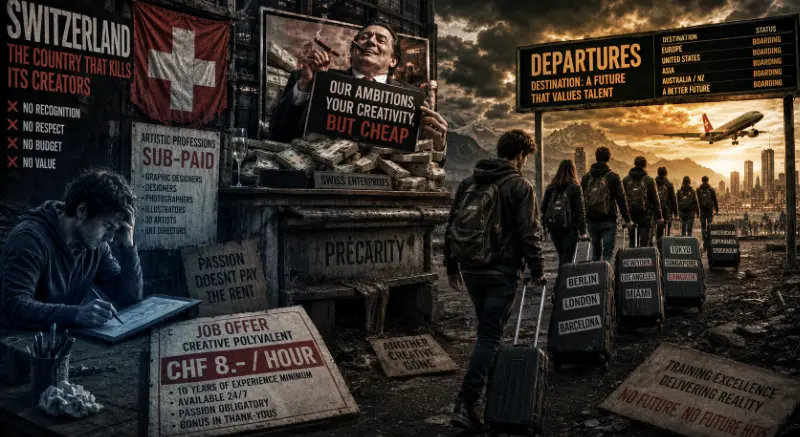
 SWITZERLAND DOES NOT REALLY KILL ITS CREATIVES... IT PUSHES THEM AWAY
The country that claims to defend innovation has become a territory where those who create are condemned to survive
Switzerland loves to talk about excellence, innovation, and creativity. But behind this well-oiled public relations machine lies a far less glorious reality: for decades, artistic and creative professions have been economically undervalued, underpaid, and increasingly precarious. Switzerland nurtures talent… and then drives it away.
My observations after forty years in the field
Since 1986, I have been self-employed in the following fields: graphic design, design, photography, imagery, and visual creation.
I have watched an exciting profession gradually transform.
I have seen once-respected professions become services that people systematically try to drive down to the lowest possible price.
I have seen my standard hourly rates from the 1990s—CHF 180. per hour systematically drop in order to compete with Ukrainians, Pakistanis, or Africans… Some of whom, it must be acknowledged, do good work. Then, when negotiations become unreasonable, I simply turn down the job; I can afford to do so because, fortunately, I still have clients with a conscience.
But there’s something far more serious!
Young people are graduating from school with remarkable skills only to discover an economic reality far less rosy than their dreams.
The case of a young graphic designer from Geneva (the daughter of a friend) who recently graduated is telling: she’s truly brilliant and talented, holds a CFC diploma with honors from her school, and is accepting a salary of CHF 5,000 per month in Geneva… And she knows full well that she won’t find anything better, so she’s actually happy with this pittance… How tragic!
This amount may seem substantial on paper to a foreigner who knows nothing about the cost of living in Switzerland… But in one of the most expensive cities in the world, after years of training and with genuine talent, it illustrates above all the absolute loss of economic recognition for a profession.
The historical comparison is even more striking: in the early 1980s, a young graphic designer with a brilliant degree started out earning around CHF 3,000–3,500 per month. Granted, the figure has gone up. But the economic reality behind that number has deteriorated considerably.
Alain Farrugia
There is a form of hypocrisy in which Switzerland has become an expert: celebrating creators when they succeed elsewhere, but ignoring them when they simply try to make a decent living from their craft here.
Switzerland adores artists who have been honored abroad. It loves to showcase its world-renowned designers, its award-winning photographers, and its admired creators. But behind the showcases and institutional rhetoric, one question remains: how many of these talented individuals could have built a sustainable career in their own country?
The answer is stark: far too few!
For as long as anyone can remember, the creative professions in Switzerland have faced a fundamental contradiction. They are expected to achieve international excellence, yet they are subject to an economic model of subcontracting.
Graphic designers, designers, photographers, 3D artists, illustrators, art directors: professions that require years of experience, visual literacy, technical mastery, and a constant capacity for innovation are too often viewed as mere interchangeable cogs in the machine.
As if creating a visual identity, a brand image, or a graphic universe were as simple as a click on a computer.
Twenty-five Years of Silent Decline
Over the past twenty-five years, the decline has become particularly evident.
Budgets are shrinking. Fees are falling. Negotiations have become a constant battle to justify a value that should, in fact, be self-evident.
The Swiss market has gradually shifted toward a dangerous mindset: comparing local creative services with offers from regions where labor costs are incomparable to those in Switzerland.
How can we expect a professional based in Switzerland, with Swiss expenses, a Swiss education, and Swiss experience—to compete with services provided in countries where a few hundred francs represent an entire month’s income?
This isn’t competition.
It’s the systematic destruction of value!
The result is inevitable: freelancers are disappearing, small businesses are closing or struggling to survive, and young talents quickly realize that their economic future lies elsewhere.
The Great Swiss Paradox—Paying Top Dollar for What Comes from Abroad, Haggling Over What’s Local
The situation sometimes reaches the point of absurdity.
Some companies will haggle for hours to save a few hundred francs on a local creative’s work.
But when an international agency comes along with a prestigious name, a lavish presentation, and a few international references, budgets suddenly skyrocket.
What was “too expensive” yesterday miraculously becomes “strategic” when it bears a foreign name.
Here’s a real-life example from 2011: I was asked to create a visual identity for a 5-star hotel in Lausanne that was rebranding, with the explicit instruction to keep my rates low… Upon checking, I found that the Leo Burnett agency at the time had charged them CHF 35,000 just for the logo redesign. I had no trouble offering a lower price, but the new owner preferred a French agency that was even cheaper—one that didn’t even bother to visit the hotel…
So the problem isn’t solely financial.
The problem is cultural.
Part of the Swiss business community still hasn’t understood that design, image, and creativity aren’t just window dressing. They are tools for competitiveness, differentiation, and economic value.
A country that neglects those who build its image ultimately loses its identity.
Art Schools - A Reflection of an Obsolete System
Decline doesn’t start only in the business world. It also begins in education.
In the 1980s, Swiss art schools were closely connected to the real world. Students were trained by renowned professionals artists, designers, and graphic artists who had genuine hands-on experience… Ahhh… the École des Arts Décoratifs in Geneva during its “Golden Age”, those of us who attended it can attest to that.
They didn’t just impart knowledge.
They instilled a spirit, a passion—but always in connection with the realities of the profession.
Today, the landscape is more complex. Art education has become more institutionalized, and some of the faculty come from academic backgrounds rather than being teachers with extensive hands-on professional experience.
Fortunately, there are still many outstanding professionals who teach with talent and maintain a connection to the real world. But the paradox remains: schools continue to train highly talented young people, while the Swiss market struggles to offer them worthy career prospects.
We produce excellence… for a market that doesn’t value it!
Switzerland produces creative talent… and then exports it
The greatest danger isn’t that creative people are leaving.
The greatest danger is that Switzerland will eventually come to view their departure as normal.
Because these young people aren’t fleeing.
They’re making a rational choice.
They go where their talent is recognized. Where creativity is considered a strategic skill. Where a designer isn’t simply seen as someone who “makes things look pretty,” but as someone who creates value.
Switzerland does not lack talent.
It lacks recognition of its talent.
And a country that forces its creators to leave in order to make a decent living from their passion always ends up importing what it failed to retain.
So the question is no longer: Why are young creatives leaving Switzerland?
The real question is: How much longer can Switzerland afford to lose those who are shaping its future?
The two videos below are representative of these creative young people who have realized that they must leave Switzerland to have their talent fairly compensated and to have hope for a future in the arts.
Vincent Levrat is a Swiss photographer who has been living in Paris for the past 8 years. / 7:30 p.m. / 2 min. / Friday at 7:30 p.m.
The second video also explains that more than a million Swiss nationals have likely moved abroad and make up the “fifth Switzerland,” a community that is growing exponentially.
Matthieu Hoffstetter discusses emigration figures in Switzerland / 7:30 p.m. / 1 min. / Friday at 7:30 p.m.
Article source: