Français
  English
 STREAMING, BITCOIN, AI: THE ENERGY CRAZE!
Watching Netflix, using a voice assistant… Behind these seemingly innocuous actions lie huge data centres and a network whose computing operations consume 8% of the world’s electricity. And this is just the beginning. Driven by streaming, AI and blockchain, their energy requirements could exceed our total energy production as early as 2040! Experts warn that this is an unsustainable situation.
We are facing a situation that will shake up the entire global economy and which will ultimately determine who has the right to access energy and who does not!!
If a sustainable and effective solution for producing abundant, cheap energy is not put in place quickly, we are heading towards a society where energy will be sold on the black market, with the kind of madness one usually only sees in science fiction films.
Alarmism and sensationalism, you might say? This article, whilst very relevant, fails to take into account Africa’s entry into mass overconsumption; and given how long they’ve been waiting, they’re very, very hungry for it… Not to mention the Asian middle class, which is booming economically – they’re not about to slow down either…
Alain Farrugia
EXPLODING COMPUTING DEMAND
1,000 MW That is the power that will be consumed by the world’s largest data centre, currently being planned in Norway. The operation of this record-breaking 60-hectare facility, located on the Arctic Circle, will thus require the equivalent of a nuclear reactor.
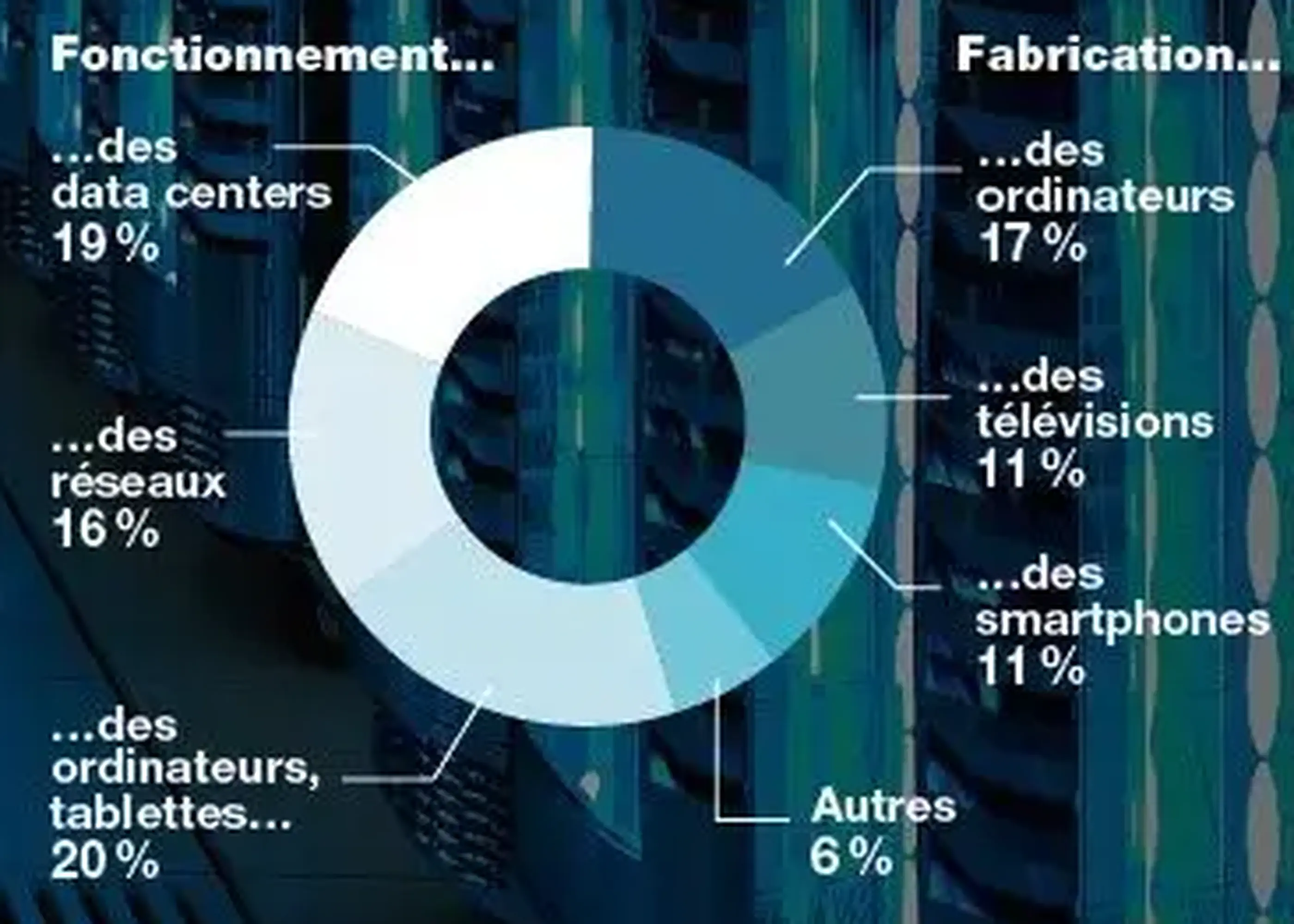
10% This is the share of electricity consumed in France by digital activities, amounting to around 40 terawatt-hours per year (a quarter of which is attributable to data centres). This is equivalent to the consumption of electric heating across France.
2040 is the year by which, given the growth of digital technology, the energy required for computing needs could exceed global energy production… if nothing is done to limit this consumption (report by Cédric Villani on AI, March 2018).
2,000 TWh This is the annual global electricity consumption attributable to digital operations, in terawatt-hours, which corresponds to the combined total electricity demand of Russia and India; if it were a country, the internet would be the third-largest consumer behind the United States and China.
These are seemingly innocuous actions: watching a series on Netflix, posting a selfie on Facebook, paying with Bitcoin, giving instructions to a voice assistant (Siri, Alexa, Google Assistant, etc.). Behaviours that we readily imagine to be light-hearted, ethereal, completely virtual and without any tangible consequences… A grave mistake.
A "DATA TSUNAMI"
For the latest studies are clear: our digital activity now consumes around 8% of global electricity production and is thought to account for nearly 4% of global carbon emissions – significantly exceeding those of maritime or air transport. And this is only the beginning. "Digital energy consumption is currently rising by 9% a year, despite significant progress in efficiency," says Hugues Ferrebœuf of the think tank The Shift Project. "Our current trajectory is verging on the doomsday scenarios envisaged a few years ago."
Internet routers, which are never switched off, account for 1% of France’s electricity consumption! –
ANNE-CÉCILE ORGERIE, Researcher at the Institute for Research in Computer Science and Random Systems

The outlook is alarming
According to researchers at the Chinese manufacturer Huawei, digital technology could account for 20% of global electricity consumption by 2025. In just six years, our online activities would therefore require the equivalent of more than 400 nuclear reactors… Worse still, according to Cédric Villani’s recent report on artificial intelligence, “by 2040, the energy required for computing needs is expected to exceed global energy production”. In short, the rapid digitalisation of our societies is leading us straight into an energy… and climate crisis.